
Written by: Li Zhuang, Taoran Gua, Bingqin Shan; Reviewed by: Nancy Shaw
In 2019, Forest City Studio launched the Shanghai Urban Biodiversity Education Base to explore active urban rewilding strategies in high-density urban areas. Unlike passive rewilding approaches common abroad, China’s dense population, fragmented green spaces, and lack of native plant supply chains create obstacles to restoring ecosystem structure and function. This project aimed to restore urban biodiversity through guided design and management, offering a replicable model for urban wilderness construction.
The 1.7-hectare site, located in Pujiang Country Park, was formerly a flat, artificial forest. The design followed five key principles:
Use native nursery stock from the Yangtze River Delta
Design quasi-natural plant communities to foster ecological succession
Diversify habitats to support wildlife movement
Create features for target species conservation
Minimize visual disturbance with low-impact infrastructure
A technical roadmap (Figure 1) guided the process from baseline surveys to habitat creation, species introduction, and long-term monitoring. The site was divided into 7 ecological zones, including Native Butterfly Attracting Zone, Native Shrub Zone, Native Aquatic Species Conservation Zone, Native Evergreen Tree Zone, Environmental Education Activity Zone, Mixed Native Evergreen/ Deciduous Tree Zone, and Native Deciduous Tree Zone to maximize habitat diversity within limited space.

Figure 1. Diagram of the technical roadmap
The site experienced a notable recovery of biodiversity in the first year. From May 2019 to November 2020, monitoring conducted with the project team and the East China Normal University recorded 260 native plant species, 255 insect species, 7 amphibian and reptile species, 71 bird species, and 6 mammals, showing higher biodiversity and animal population density than unrestored artificial forests nearby. Invasive species cover dropped from 65 percent to 5 percent in 1 year through competitive planting of pioneer species. In addition, maintenance has remained minimal by eliminating chemical control and relying on ecological processes such as natural pest regulation and nutrient cycling through deadwood decomposition.

Figure 2. Before restoration, the site was dominated by Alternanthera philoxeroides and Trifolium repens, with dead Ligustrum lucidum in the background.
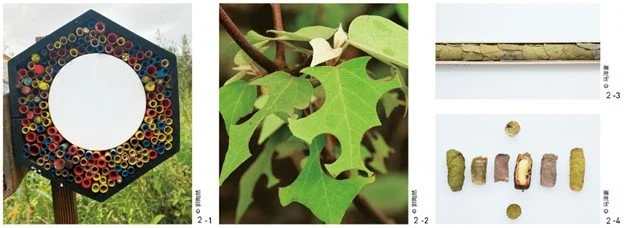
Figure 3. Seven bee hotels filled with reed stalks were installed across different habitats, successfully attracting Megachilidae spp.and providing evidence of their nesting preferences.
Since its public opening in May 2020, the site has hosted 18 environmental education programs with 4,500 participants, including a nocturnal wildlife observation event that attracted over 1,500 visitors. Interpretive signage and citizen science activities further enhance its role as a living laboratory for biodiversity restoration and public engagement.
The project demonstrates the technical feasibility of active rewilding in large Chinese cities through habitat division, native species introduction, natural community construction, and ecological benefit assessment. It provides valuable insights for future applications in country parks, ecological corridors, and environmental education bases. However, limitations remain, particularly in balancing biodiversity goals with recreational use, which the team plans to address in future projects. Active urban rewilding still requires further research and policy support in China, but this case shows its ecological and social benefits are both achievable and scalable.