In fall 2019, the Fort Belknap Indian Community (FBIC) launched a promising 5-year partnership with the Bureau of Land Management (BLM) and the Society for Ecological Restoration (SER) to implement the Seeds of Success (SOS) Native Seed and Grassland Restoration Program. Our program focuses on the role of Traditional Ecological Knowledge (TEK) in ecological restoration, working in close partnership with FBIC on BLM and adjacent tribal lands on Montana’s Northern Great Plains.
Seed-based Restoration: How experiences in Brazil are increasing in both scale and co-benefits
Direct seeding has expanded as a method for ecological restoration on degraded areas with low natural regeneration potential in Brazil. Results demonstrate ecological and reduced costs, in addition to generating income and social opportunities for marginal communities that have preserved ecosystems and are now engaged in supplying seeds for a growing native seed market. In order to spread the use of this restoration strategy, a multiple-stakeholder initiative was created in 2019, focused on up-scaling adoption of the method and matching its growth with native seed production. Hence, we present the Seed Paths Initiative (Iniciativa Caminhos da Semente, in Portuguese), framing lessons learned and recommendations for structuring the seed production chain and expanding direct seeding adoption and its social benefits among restoration projects in Brazil.
Launch of world’s first international standards for native seeds in ecological restoration
INSR is pleased to announce that the First International Principles and Standards for Native Seeds in Ecological Restoration are now available as an Open Source Special Issue of Restoration Ecology.
To access the special issue, click on the image below.
The growing demand for native seeds in ecological restoration and rehabilitation has resulted in a $1 billion global industry in the sourcing, supply, and sale of native seeds. Until now, there has been little international guidance for ensuring native seeds have the same standards of quality assurance that are already regular practice in the crop and horticultural industries. Using the SER International Principles and Standards for the Practice of Ecological Restoration as a foundation document, INSR synthesized general practices in the native seed supply chain. They derived the Principles and Standards for Native Seeds ("Seed Standards") from this synthesis. These practices and the underpinning science provide the basis for developing quality measures and guidance statements that are adaptable at the local, biome, or national scale. Importantly, the Seed Standards define what is considered native seed in ecological restoration and highlight the differences between native seeds versus seeds of improved genetics. The Seed Standards are not intended to be mandatory, however, the guidance statements provide the foundation upon which regulatory approaches can be developed by constituencies and jurisdictions.
Seed ecology and restoration practice to reestablish fynbos vegetation after alien plant invasion
In a critically endangered vegetation type within the mega-diverse fynbos biome in the Cape Region of South Africa, passive and active interventions were compared in terms of restoration success following removal of invasive Acacia saligna, since this ecosystem is a good example of where clearing alone has often failed to facilitate recovery of the native ecosystem.
Australian Native Seed Survey Report
Workshop on accessible seed pelleting and drone technologies for restoration in Brazil
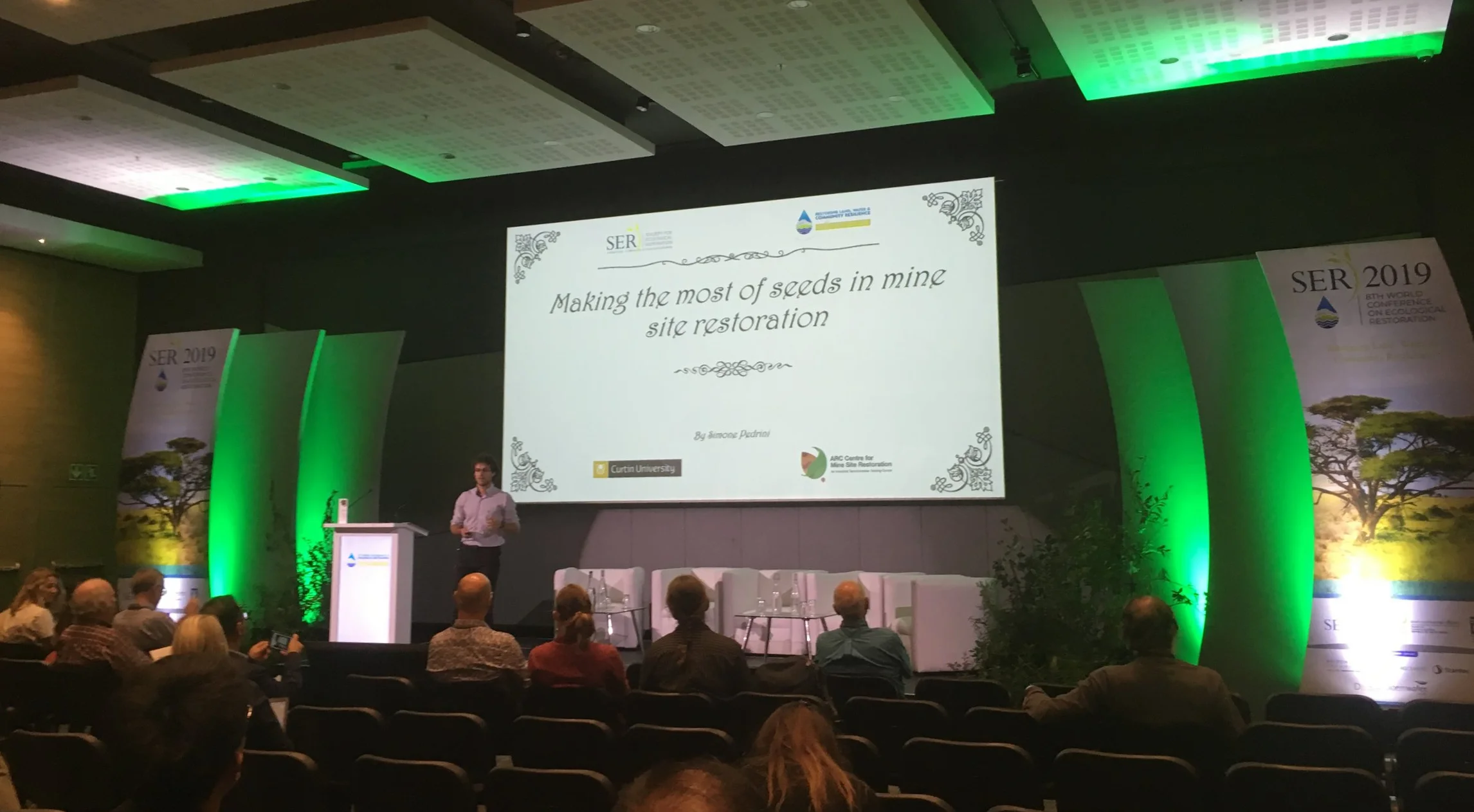
INSR at SER2019 - Science, Debate and Networking around Seeds for Restoration
Restoration potential of soil seed bank in a changing climate
In a recent special issue in Restoration Ecology, the main topics were seed dispersal and seed bank ecology. In one of the review papers published in that issue we synthesized the existing knowledge about the seed bank of various open habitats and the effect of climate change on them. Due to the very few direct climate manipulation studies in open habitats with respect to soil seed bank, we provided a new perspective to reveal the possible effect of climate change on the soil seed bank.
Using the Soil Seed Bank to Inform Ecological Restoration in a Colorado Semi-arid Shrubland
Restoring Habitat and Hope
Ethical seed sourcing is a key issue in meeting global restoration targets
Hundreds of thousands of tonnes of wild seeds are needed to restore plant ecosystems globally but over harvesting risks their depletion unless ethical seed-sourcing regulations are developed, Curtin University research has found. A paper, just published in journal Current Biology, concluded that inadequate regulatory frameworks controlling wild-seed sourcing, limited farming capacity and seed wastage are impeding moves towards the sustainable practice of native-seed collection.
Soil seed banks: a sneak preview into the future
Many arid land plants possess seed dormancy, enabling them to delay germination until receiving environmental cues that stimulate development. Dormant seeds within the soil create seed banks that are a valuable resource for regeneration of native plant communities after disturbance. Seed germination and soil seed bank research is important to better understand soil seed bank dynamics, appropriately select restoration seed mixes, and gauge the restoration potential contained within existing soil seed banks.
Seed-based restoration of damaged Mediterranean coastal habitats: the Sardinia case
The Mediterranean Basin is one of the most important plant diversity hotspots worldwide; however, its sandy coasts are affected by strong erosive processes, also accentuated by the disappearance of dune and submerged vegetation caused by human exploitation. Therefore, in the Mediterranean area the plant species conservation and ecological habitat restoration are of major importance for sustainable development.
ESA 2018: Emerging Topics in Native Plant Materials Workshop
Advances in plant ecology and evolutionary biology have clear applications to plant materials choices for ecosystem management that may have long-term impacts on ecosystem resilience. There is a need to balance the preservation of locally adapted genes with the desire to develop native plant materials that are genetically diverse and can respond to ecosystem changes.
Strategies to enhance biodiversity at SECIL. Outão Plant, a unique case study
SECIL-Outão plant is located within a Natural Park and a Natura 2000 site, south-west Portugal. The exploitation area covers about 99 ha, which includes two active quarries, one for limestone and one for marl. Both quarries and the cement plant are surrounded by natural areas, which cover about 425 ha.
The International Seed Society’s Second Seed Longevity Workshop
The USDA Agricultural Research Service’s National Laboratory for Genetic Resources Preservation hosted the International Society for Seed Science’s (ISSS) Second Seed Longevity Workshop at Colorado State University in Fort Collins, on July 20 – August 1, 2018. About 100 participants from 22 countries attended. ISSS aims to foster and promote research, education and communication in the scientific understanding of seeds. The workshop is held to discuss current findings and propose new directions for future research on seed longevity. Papers from the meeting will be available later in a Special Issue of Seed Science Research “Seeds, Conservation and Biodiversity”.
Roadside Revegetation – An Integrated Approach to Establishing native Plants and Pollinator Habitat and the Ecoregional Revegetation Application Tool
Roadsides can play an important role in the conservation of both native plants and declining wild and managed pollinator species. In an effort to enhance the success of roadside revegetation projects and create habitat that is favorable for pollinators, the US Department of Agriculture, Forest Service (USFS) and Federal Highway Administration (FHWA) partnered with the Xerces Society for Invertebrate Conservation and Chicago Botanic Garden to release a new DRAFT manual: Roadside Revegetation – An Integrated Approach to Establishing Native Plants and Pollinator Habitat.
Ed Toth Awarded the New York City Sloan Public Service Award
How to pellet seeds
This publication provides the first public domain and practical step-by-step guide on how to do seed pelleting, along with the list of materials and equipment needed. These instructions and materials will help scientists develop seed coating technologies capable of overcoming logistical and biological barriers to the more effective use and deployment of native seed across the world while enabling the native seed industry to improve seed-based restoration.
Formation of the European Native Seed Producers Association
A Dutch, a French and an Irishman walk into a German native seed farm.
That’s quite a good start for a joke based on national stereotypes. But when the Dutch, French and Irishman are followed by the Scottish, Spanish, Danish, German, Italian, English, Swedish, Czech, Polish, Swiss, Austrian and a Portuguese (on crutches) the joke might be getting a bit out of hand. And they’re not visiting just one farm. They’re on a mission to fit as many native seed companies as possible in a super tight five days schedule across most of Germany, and Switzerland.